Healthcare UX
Design Stories
Healthcare UX from Touchpoints to Systems
In real life, care does not work in isolation. When someone is unwell, many factors influence their experience, starting with the patient and extending to their family members, caregivers, doctors and nurses, pharmacies, hospitals, policies, digital systems, social support, financial situation and even where they live.
Healthcare products are generally designed with patient safety and well-being in mind.
But in real life, care does not work in isolation. When someone is unwell, many factors influence their experience, ranging from the patient to their family members, caregivers, doctors and nurses, pharmacies, hospitals, policies, digital systems, social support, financial situation, and even where they live.
Because of this network of influence, the design strategy should focus not just on the patient but on the entire ecosystem.
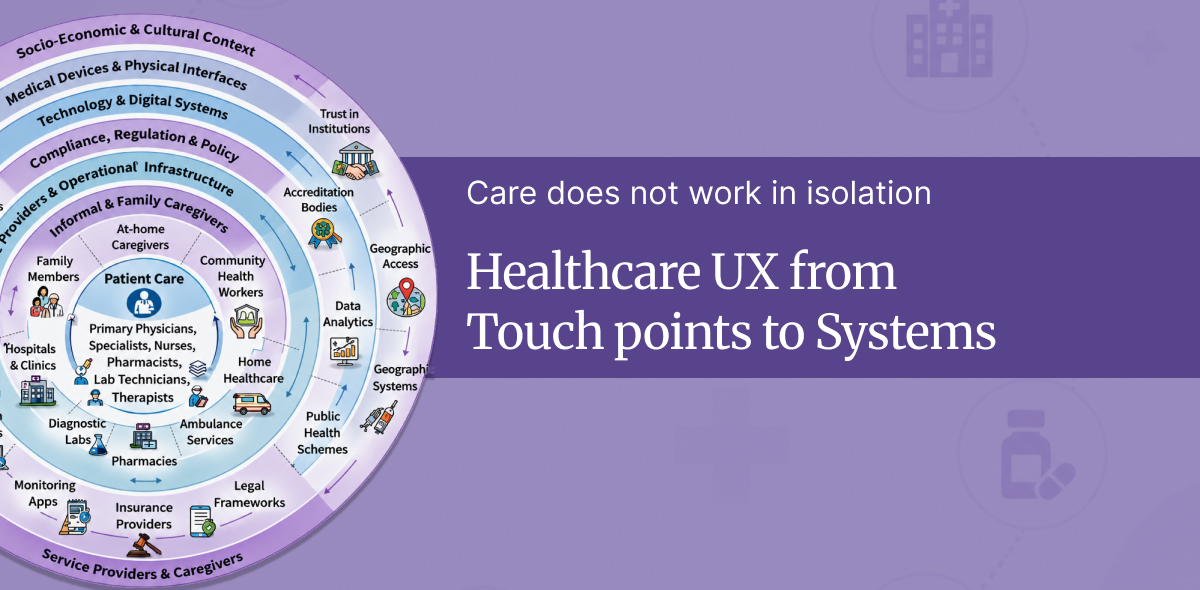
Each layer of the ecosystem impacts the experience differently and serves a specific purpose.
Family and Caregivers: They influence medication adherence, appointment coordination, symptom observation and decision-making.
Health care professionals: Doctors, nurses, pharmacists, lab technicians, therapists influence diagnosis, medication safety, and build confidence in patients and care quality.
Service providers: Hospitals, clinics, diagnostic centres, pharmacies, and ambulance services influence the speed of access, continuity of care and overall system friction.
Compliance, Regulations and Policies: Insurance providers, Health regulators, and Public health schemes influence treatment pathways and financial accessibility.
Technology and digital systems: Monitoring apps, telemedicine, messaging tools, and EMAR are playing a key role in Data Visibility, information availability, error detection and coordination.
Socio-economic and cultural factors: Income levels, cultural beliefs, geographical access and trust in hospitals or institutions influence their acceptance of treatment and care behaviour.
Each of the layers in the care-ecosystem needs to be considered while designing any care product and should be factored in within each circle. No care system can exist outside this context and influences Access speed, continuity of care and system friction.
The Shift: From Touch Points to Systems
Health care design should move beyond isolated touch points and towards systems thinking.
Care involves distributed responsibilities. The system should be designed for multiple roles with distributed responsibilities and transparency of actions across each role.
Design should provide clarity in action and answer questions like when to contact the doctor, what the defined thresholds are, and what action to take.
Healthcare decisions are made under pressure. Design must reduce cognitive load by minimising interpretations and preventing high-risk errors through confirmations.
Ensure the entire loop remains connected. example: Appointments -> Prescription-> Medications -> Followups.
Design for friction and resilience. Consider edge cases, error states, and failure pathways, and maintain continuity.
In healthcare, competitive advantage does not come from adding features but from reducing breakdowns and ensuring continuity. This, in turn, builds trust.
Ecosystem-level design strategy provides a stable infrastructure.
The goal in healthcare products is not just usability, but designCreating products or solutions that are user-centred and solve real problems while being useful, usable, desirable, accessible, and valuable, both for the user and the business. for resilience and the entire ecosystem
Have a story to share?
Join our community of designers sharing their experiences and insights.
Share Your Story