Career & Success
Design Stories
The First In-House Designer in a Scale-Up
Most designers join their first scale-up role with genuine excitement. It feels like a great opportunity. This blog speaks to the quiet, often unspoken challenges designers face at this stage of a company’s growth.
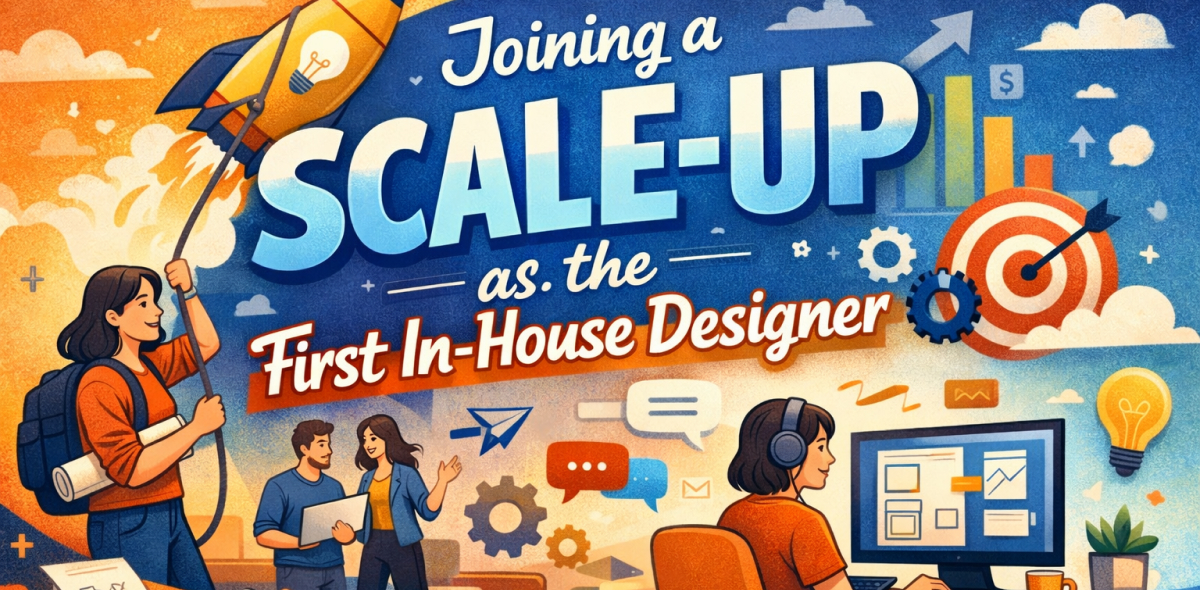
The First In-House Designer in a Scale-Up
If you are the first in-house designer joining a scale-up or stepping into a product that was shaped by external consultants, developer-led decisions, or Product Owner–driven workflows, this will probably feel familiar. This blog speaks to the quiet, often unspoken challenges designers face at this stage of a company’s growth.
Most designers join their first scale-up role with genuine excitement. It feels like a great opportunity; building design foundations from scratch, shaping research practices, defining interaction and visual language, and influencing how design shows up across the product and organisation. There is a strong sense of ownership and control, the belief that you finally get to design the right way.
And yes, it is exciting. But it is also far from smooth.
In reality, this phase is one of the most complex phases for the designer and for the product team alike. When a scale-up hires its first designer, it is often positioned as a milestone of maturity. There is an unspoken assumption on both sides that things will now “GET BETTER.”
What usually gets overlooked is how much complexity already exists beneath the surface.
It starts with owning a Product designed by many hands. Before the first designer arrives, design decisions rarely come from a single place. Developers make UI decisions based on feasibility. Product Owners define workflows around delivery pressure. External agencies focus on shipping specific features, not long-term continuity or scale. The result? A fragmented product with little clarity around intent, no shared understanding of users, no clear problem framing, and no documented rationale behind decisions. The first designer inherits all of this, but without the context. Documentation is almost always missing. User journeys are either outdated or nonexistent. Yet, delivery pressure starts on day one. Designers naturally seek a holistic view, but instead they are pulled straight into feature-level execution, often with minimal inputs and strong opinions from engineering or product. Without understanding why past decisions were made, designers are forced to reverse-engineer logic or challenge assumptions. Knowledge is scattered across people rather than systems. Designers spend their initial months navigating conversations, connecting dots between stakeholders, users, workflows, business goals, technical constraints, tools, repositories, and delivery processes. At the same time, they are expected to start laying the foundations for design structure, process, and culture.
Very quickly, reality sets in. There is no design system, no research practice, and no clear design ownership. The role sounds strategic, but the day-to-day work is deeply tactical.
Then, as the real work begins and you step into the demo, you realise there’s another twist waiting. After investing time in understanding the product, building initial mockups or prototypes, and finally presenting a considered solution, the designer often feels blindsided. Technical constraints suddenly surface. Constraints that were never raised during earlier discussions. Feasibility concerns appear only during reviews, not during discovery.
Not to forget, there is also the inevitable question and push back "Why change this now?" or "Can we do it in the next phase?" or "Is there a simpler faster solution for this problem?"
Legacy decisions become political. Product Owners worry about delays when designers suggest addressing root problems instead of applying quick fixes. What often goes unrecognised is that design debt is not just technical, it is emotional. It affects user trust, clarity, and confidence.
This creates a dangerous incentive. "Polishing instead of stabilising."
So, What Actually Makes This Transition Successful?
First, acceptance.
If you are stepping into this role, expect friction. Expect resistance. Expect moments where progress feels painfully slow. This is not a failure; it is the nature of the role!
An entire organisation is being asked to unlearn old habits while learning new ones. Be open to criticism and pushback. Make it clear that your role is not just about visible UI improvements. As the first designer, your responsibility is to align user needs with product, technology, and business goals. Move slowly at first. Trust matters more than speed. Explain why decisions are being made, especially during demos. Bring user perspectives into every conversation. Share stories from your research and discovery with real user interactions. Connect design choices to usability, business outcomes, and best practices. Help the team define what “good design” actually means for their business. Balance speed with craft, especially in high-pressure environments. Start small but intentionally:
Define basic workflows (discovery → design → validation → handoff)
Create collaboration rituals with Product Managers and engineers. Set lightweight documentation standards; even minimal documentation is better than none.
Documentation will always feel like the hardest thing under tight deadlines, but it is foundational. Over time, it reduces dependency on individuals and builds shared understanding. As the team grows, mentor junior designers. This is often the point where you can begin shifting from purely tactical execution to strategic influence. A First Design Lead truly feels successful when design is involved early in product discussions, when decisions are informed by user insight rather than assumptions. When Engineers and Product Owners see design as a partner, not a blocker. When design is treated as a system, not a service.
Hiring a senior or lead designer does not magically mature design. It exposes everything that came before. When done well, the designer becomes a stabilising force bringing clarity, alignment, and direction to what was once scattered.
Have a story to share?
Join our community of designers sharing their experiences and insights.
Share Your Story