User Research
Design Stories
Evolving Personas: Designing for Tomorrow's Personas
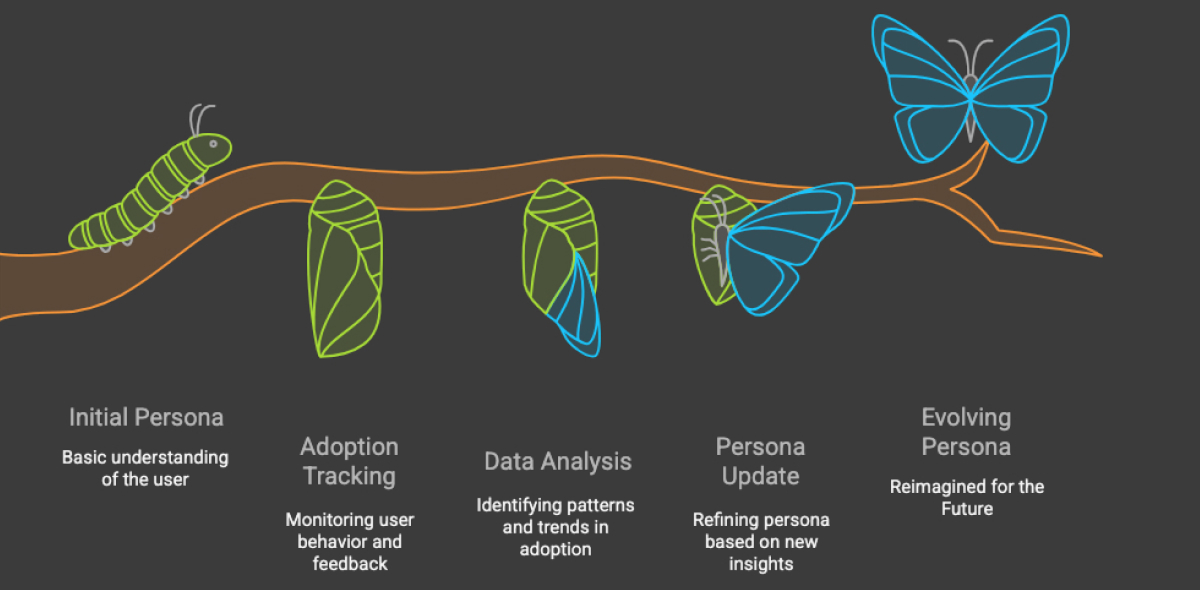
I see personas less as static templates and more as living, evolving, breathing stories.
Evolving Personas
A few weeks ago, I sat down to revisit some personas I had created over the last couple of years. What started as a quick refinement exercise turned into an eye-opener.
Looking back, I realised just how much these personas had changed. Two years ago, many of them were hesitant to use digital tools. A year later, they were cautiously trying them out, and today, many of those same personas are asking for new features and better integrations.
That shift got me thinking! Personas are not static. They evolve, just like people do. And if we are not tracking and adapting those transitions, we are missing a huge part of the story. This got me re-thinking on my experiences, Digital Payments in India being the major one in my memory.
Digital Payments in India
One of the biggest transformations I have personally witnessed came during Digital India’s rise. When the pandemic hit, people were suddenly pushed toward digital payments. Honestly, at first, considering the huge population in India who were non-tech savvy, I assumed users would struggle. But the opposite happened.
Street vendors who barely used smartphones were suddenly scanning QR codes and accepting UPI payments. What made this possible? The urgency of the situation, government support like zero-balance accounts, QR Code technology and good design made the adoption simple.
I saw how personas that once looked “static” could take giant leaps forward almost overnight.
This recall is what clicked! It’s not enough to record who our users are today. We need to capture "How they got here?" and "Where they might be headed?"
When we look at transitions, we start to see patterns such as:
- A hesitant user becomes a confident one.
- A non-digital persona suddenly leading the way in product adoption.
- A younger generation is reshaping the same role with completely different expectations.
When we capture these stories, we are not just documenting the past and present; we are forecasting the future.
Designing for Tomorrow’s Personas
I have now started adding a “probable evolution” section to my persona work. It’s a simple addition, but it forces me (and the team) to think beyond today:
- Will this user become more tech-savvy in the next few years?
- How might policy changes or global events shift their behaviour?
- What happens when Gen Z enters the same role we have been designing for?
Good design reduces friction for today. But great design anticipates where users are heading. Recording transitions helps us do just that.
As I look back at the personas I created two years ago, I realise they weren’t wrong, they were just incomplete. They didn’t show the journey, but only a snapshot of that period of time. Now, I see personas less as static templates and more as living, evolving, breathing stories.
Just like most of you, I had created a basic persona with needs, goals, motivations, pain points and demographics, but I am making small additions that I am confident will make a shift in the product design.
Past Transitions
(What changes have already happened? Capture the timeline.)
- 2 Years Ago
- 1 Year Ago
- 6 Months Ago
- Today
Triggers of Change
(Events, trends, or forces that influenced their evolution.)
- External (e.g., pandemic, regulations, market shifts)
- Internal (e.g., company adoption, personal confidence, generational change)
- Design/Technology factors (e.g., simplified UI, QR codes, integrations)
Probable Evolution (Next 2–3 Years)
- Tech Trajectory: (e.g., “From hesitant → confident → power user”)
- Behavioural Shifts: (e.g., “Requests advanced analytics instead of basic reporting”)
- Future Expectations: (e.g., “Seamless, personalised, mobile-first experiences”)
Design Implications
(What should product teams consider to stay ahead?)
- Short-Term Design Needs
- Long-Term Opportunities
Below is a simplified version of the above additions:
Persona Snapshot Today: Street vendor using QR-based UPI payments.
Past Transitions:
- 2018: No smartphone usage
- 2019: Started using WhatsApp
- 2020: Adopted UPI due to demonetisation & COVID
- 2022: Confidently using digital payments
Triggers of Change: Government push, situational needs, QR code simplicity.
Probable Evolution: May start using simple digital bookkeeping apps.
Design Implications: Create lightweight, mobile-first financial tools with trust-building features.
What research methods should be used to understand the Shift in Personas?
Qualitative (for “why” behind changes):
- Interviews: 10–15 semi-structured sessions to explore motivations
- Focus Groups: 2–3 groups (6–8 people) to discuss collective shifts
- Ethnography: Observe users in real settings for 1–2 weeks to identify behavioural changes.
Quantitative (for scale and validation):
- Surveys: 100+ respondents to quantify trends
- Behavioural Analytics: Track digital data (e.g., app usage) to confirm shifts.
- A/B Testing: Test variations to measure behaviour changes (e.g., feature adoption).
- Data Analytics: Analyse large datasets to identify patterns (e.g., new user segments).
Approach: Start with qualitative methods (interviews, focus groups, ethnography) to uncover themes, then use quantitative methods (surveys, analytics, A/B testing) to validate and scale findings.
So the next time you are refining personas, ask yourself: “How did they get here? And where might they be going?” The answers might just shape your product vision for years to come.
Have a story to share?
Join our community of designers sharing their experiences and insights.
Share Your Story