Foundations
Beginners Guide
Design Thinking vs Lean UX: When and How to Use
Today, AI is the hot buzzword in every industry. But if we go back a couple of decades, the term that had captured everyone's attention was Design Thinking.
Design Thinking vs Lean UX
Today, AI is the hot buzzword in every industry. But if we go back a couple of decades, the term that had captured everyone's attention was Design Thinking. Firms like IDEO popularised it in the early 2000s, and by 2010, large organisations such as IBM, Procter & Gamble, and SAP had embraced Design Thinking to improve innovation and customer experiences. Soon after, new-age disruptors like Airbnb, Spotify, Uber, and Citrix followed the same path.
The Evolution of Design Methodologies
Both Design Thinking and Lean UX emerged from the need to create more user-centred products. While they share similar goals, their approaches differ significantly. Design Thinking emphasises empathy and a deep understanding of user needs, while Lean UX focuses on rapid iteration and quick validation of assumptions. Both methodologies value collaboration and user feedback.
What is Design Thinking?
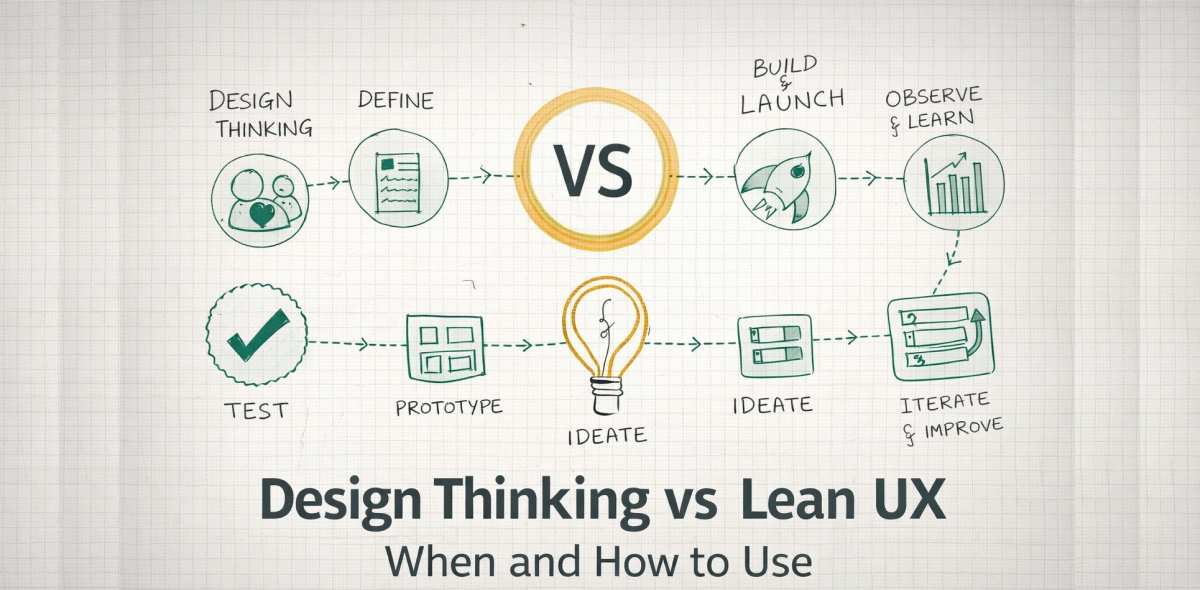
Design Thinking is a human-centred, iterative framework focused on deeply understanding user needs and solving the right problems. Its 5 core stages are: 1) Empathise - Understand users in their real environments and contexts. 2) Define - Reframe the problem statement based on insights. 3) Ideate - Generate a wide range of possible solutions. 4) Prototype - Build quick models or mock-ups of ideas. 5) Test - Validate prototypes with real users, gather feedback, and iterate.
The Rise of Lean UX
Lean practices were already popular in manufacturing, with a strong focus on waste elimination, efficiency, and just-in-time production. These principles were then adapted for a digital platform, which we call Digital Lean, combining technology and real-time data to drive continuous innovation. From this evolved Lean UX, which brought Lean principles directly into product design.
What is Lean UX?
Lean UX is a fast, collaborative, and experiment-driven approach to product design. It focuses on building just enough to learn quickly, validating assumptions, and getting a Minimum Viable Product (MVP) into the market. Its 4 core stages are: 1) Ideate & Prioritise - Brainstorm hypotheses, prioritise features with cross-functional teams. 2) Build & Launch - Release with the chosen features and refine in small cycles. 3) Observe & Learn - Collect feedback, analyse data, and reflect on learnings. 4) Iterate & Improve - Refine high-value features and drop what doesn't work.
Design Thinking vs. Lean UX: A Side-by-Side Comparison
Here's a quick comparison of where each fits best:
| Aspect | Design ThinkingA human-centred methodology focused on empathy, ideation, prototyping, and testing. It encourages creative problem-solving and innovation. | Lean UXA collaborative and experiment-driven UX approach emphasising rapid validation and iteration. It reduces documentation in favour of testing and learning. |
| When to Use | Starting a new initiative with many unknowns. Rethinking user experienceUser Experience (UX) focuses on how a person feels while interacting with a product. It focuses on usability, accessibility, and overall user satisfaction. from scratch or working on a strategic problem. Use when the problem space is undefined or ambiguous, you need to understand complex user problems, and you have time for thorough research and exploration. | Use when resources are limited, and time is crucial. You are working in an agile development environment, validating assumptions quickly, improving an existing product, or making tactical enhancements. |
| Focus | Empathy, problem discovery, innovation | Speed, collaboration, real-world testing |
| Output | Insights, problem statements, fresh ideas | Validated learnings, product enhancements, faster releases |
| Value | Avoids building the wrong product, enables innovation, drives long-term retention | Reduces waste, increases product–market fit, prioritises features with data |
| Time | Longer upfront investment, long-term payoff | Shorter cycles, faster ROI |
| Risk | Avoids risk of solving the wrong problem | Avoids risk of shipping the wrong feature |
| User Perspective | Users feel heard through interviews, workshops, and observations | Builds trust with frequent improvements and visible changes |
| StakeholderAny individual or group with an interest in a project’s outcome. Stakeholders influence priorities and decision-making. AlignmentThe structured positioning of elements in a layout to create visual order and clarity. Proper alignment improves readability and creates a more professional appearance. | Shared understanding, empathy for user pain, feasibility and viability validated early | AlignmentThe structured positioning of elements in a layout to create visual order and clarity. Proper alignment improves readability and creates a more professional appearance. around hypotheses, evidence-based validation, faster buy-in with visible results |
| Collaboration Style | Workshops, co-creation, divergent thinking | Stand-ups, sprint reviews, demos, retrospectives |
| Technology Role | Tech included early for feasibility, but heavy involvement comes later | Tech is hands-on from the start, building prototypes and experiments |
| Market Impact | Helps discover new opportunities and differentiators | Responds quickly to market trends, competitive adaptation |
| Cultural Impact | Encourages user empathy, breaks silos, builds shared understanding | Builds evidence-driven culture, encourages test-learn-iterate mindset |
In practice, the two approaches complement each other:
- Start with Design Thinking
- Conduct research, empathise, and uncover insights.
- Define the problem statement clearly.
- Explore multiple solution ideas.
- Shift to Lean UX - Frame promising ideas as hypotheses.
- Prototype, release quickly, and gather feedback.
- Iterate continuously based on learnings.
In my experience, Design Thinking and Lean UX are not rivals but partners. Each has its place in the product lifecycle. Together, they help teams build user-friendly, innovative, and successful products while driving business value. Just as Design Thinking and Lean UX defined the last two decades of innovation, AI is defining the next. The big question is - will we apply the same principles of empathy, iteration, and rapid learning to shape this new era of intelligent product design?
However, innovation frameworks didn't stop there. Startups, especially in the 2010s, were under constant pressure to get products out faster, validate quickly, and keep costs low. This led to the rise of Digital Lean and eventually Lean UX.
Have a story to share?
Join our community of designers sharing their experiences and insights.
Share Your Story