Design Leadership
Design Stories
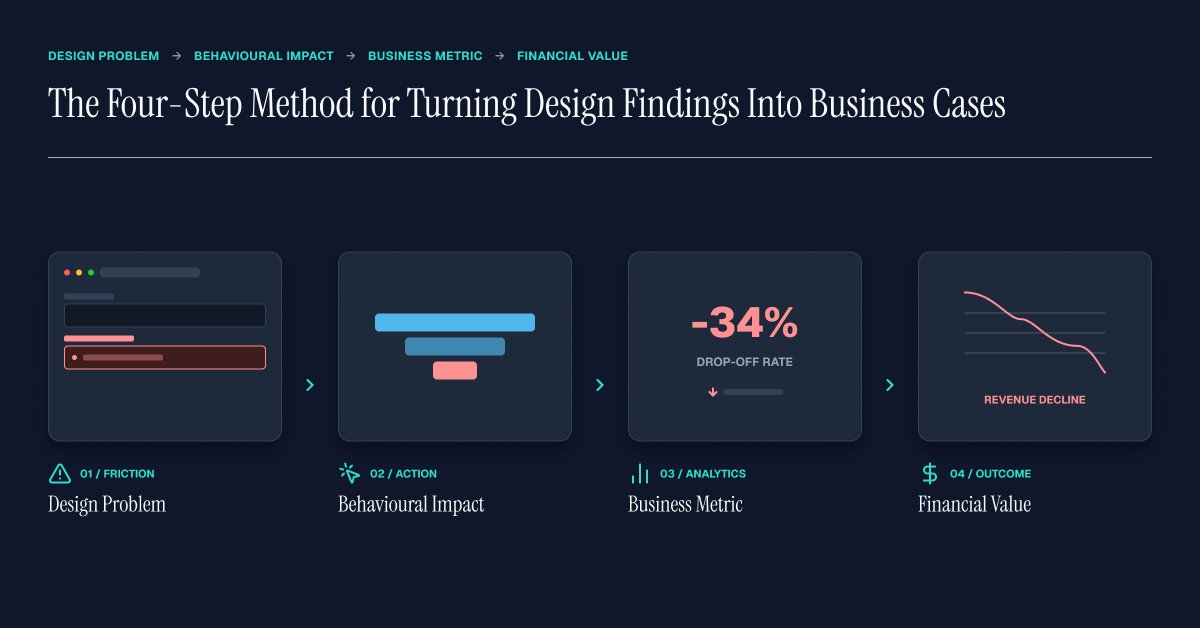
The Four-Step Method for Turning Design Findings Into Business Cases
A design finding becomes more actionable when it is connected to measurable business impact. This four-step method helps designers move from identifying a design problem to quantifying its behavioural, business, and financial implications—making design recommendations easier to prioritise, fund, and measure.
The Four-Step Method for Turning Design Findings Into Business Cases
A designer identifies a checkout flow with too many steps. The observation may be accurate, but on its own, it doesn't make a strong business case.
A PM may hear a UX concern. An engineer may hear another item for the backlog. A finance leader may ask, “What does this change mean for the business?”
The opportunity is to connect the design finding to what the organisation already measures: conversion, revenue, retention, support costs, engineering effort, operational efficiency, or risk.
The design problem is only the starting point. The business case emerges when we connect that problem to measurable impact.
This can be done through four simple steps:
Design problem → Behavioural impact → Business metric → Financial impact
Start with the specific design issue you have identified. Avoid broad statements such as “the experience isn't good” or “the interface feels confusing.”
Be specific about what is happening.
“The checkout has too many steps.”
Or:
“Search results don't surface relevant items first.”
A precise problem creates a stronger foundation for everything that follows.
Step 2: Identify the Behavioural Impact
Next, connect the design problem to what customers or users actually do.
For example:
“The additional checkout steps increase abandonment.”
Or:
“Users abandon search, switch to manual browsing, or leave the site.”
This is where design observation becomes measurable customer behaviour.
Step 3: Connect Behaviour to a Business Metric
Now identify the metric that captures the business impact of that behaviour.
For checkout:
“Checkout abandonment is currently 12% above benchmark.”
For search:
“Search-originated sessions convert 30% lower than category-browse sessions.”
This step is critical because it moves the conversation from an interface problem to a business performance problem.
Step 4: Quantify the Financial Impact
Finally, translate the business metric into financial value where the data allows.
For example:
“Reducing checkout abandonment by that margin could recover roughly $Y in monthly revenue.”
Or:
“Closing the conversion gap across our current search traffic could generate an estimated $Z in recovered monthly revenue.”
The resulting chain looks like this:
Design problem
“The checkout has too many steps.”
↓
Behavioural impact
“The additional steps increase abandonment.”
↓
Business metric
“Checkout abandonment is 12% above benchmark.”
↓
Financial impact
“Reducing abandonment could recover approximately $Y in monthly revenue.”
This is the difference between reporting a design problem and building a business case for solving it.
What If You Don't Have the Financial Number?
Not every design finding will have an immediate dollar value. That doesn't make the finding less valuable.
What matters is being clear about what you know, what you don't know, and how you will validate the business impact.
Instead of saying:
“This will increase conversion by 15%.”
Say:
“We expect this change to improve conversion. An A/B test will quantify the impact.”
Or:
“We hypothesise that this will reduce funnel abandonment. The proposed experiment will help us size the potential revenue impact.”
This approach is more credible than attaching an unsupported financial number to a design recommendation.
A strong business case doesn't pretend to have certainty where none exists. It makes the assumption visible and defines how it will be tested.
The Vocabulary Audit
The language you use can determine whether a design finding is treated as a subjective opinion or a business opportunity.
The goal isn't to eliminate design terminology. Words such as “friction,” “empathy,” “whitespace,” and “usability” remain useful within the design discipline.
The shift happens when communicating across functions.
Instead of stopping at:
“There is too much friction.”
Translate it into:
“This friction is contributing to a 12% drop-off in the funnel.”
Instead of:
“We need more whitespace.”
Translate it into:
“Increasing visual separation could improve CTA engagement and conversion.”
Instead of:
“We need user research.”
Translate it into:
“A small validation investment can reduce the risk of committing a larger engineering budget to an untested assumption.”
The question is not “What design terminology should I avoid?”
The better question is:
“What business outcome does this design finding influence?”
| Instead of saying | Say instead |
| Delight | Retention, engagement, satisfaction, repeat usage |
| FrictionAny obstacle that slows down user progress. Reducing friction improves conversions and retention. | Drop-off, task failure, abandonment, conversion leakage |
| Empathy | Customer insight, behavioural evidence, segment understanding |
| WhitespaceThe space around elements in a layout. It improves focus, readability, and visual balance. | Visual hierarchyThe arrangement of elements to indicate importance.Visual hierarchy guides user attention effectively., information prioritisation, conversion impact |
| Clean UI | Reduced cognitive loadThe mental effort or resources required to use a product or complete a task. Reducing cognitive load improves usability and user satisfaction., improved task completion |
| ConsistencyThe use of uniform patterns, components, and behaviours across a product. Consistency improves learnability and reduces user confusion. | Operational efficiency, implementation speed, reduced defects |
| Design systemA centralised collection of reusable UI components, design guidelines, and standards that ensures consistency, efficiency, and scalability across digital products. | Reusable infrastructure, development efficiency, cost reduction |
| User researchThe systematic study of users to inform design decisions. It combines qualitative and quantitative methods. | Risk reduction, validation, investment protection |
| Usability | Task completion, support reduction, operational efficiency |
| AccessibilityThe practice of making products and services usable by people with disabilities, ensuring equal access and opportunity for all users. | Compliance, market expansion, risk mitigation |
| PersonaA fictional character representing a target user group. Personas are based on research and guide design decisions. | Customer segment, revenue cohort, behavioural segment |
| Journey | Funnel, lifecycle, conversion path |
| OnboardingThe process of introducing new users to a product’s features and value. Effective onboarding increases adoption and retention. | Activation funnel |
| Engagement | Product adoption, frequency, retention |
| Delightful onboardingThe process of introducing new users to a product’s features and value. Effective onboarding increases adoption and retention. | Faster activation and improved Day-1/Day-7 retention |
| Prototype | Risk-reduction mechanism |
| Iteration | Optimisation cycle |
| Design debtRepresents accumulated user experience (UX) and interface inconsistencies resulting from shortcuts, rapid, or incomplete design decisions made to meet short-term goals. It creates long-term maintenance issues, reduces team velocity, and lowers user satisfaction by making products clunky or inconsistent over time. | Operational inefficiency, maintenance cost, delivery risk |
| Better experience | Improved business performance |
A strong design finding doesn't stop at identifying what's wrong. It explains why the problem matters to the business.
“The checkout feels clunky” is a design observation.
“Checkout abandonment is 12% above benchmark, creating an estimated $Y in monthly revenue leakage” is a business case.
Both may describe the same underlying problem. The difference is that the second connects the design issue to a measurable outcome.
The four-step method is simple:
Design problem → Behavioural impact → Business metric → Financial impact
Use it to turn design observations into evidence-backed recommendations that can be prioritised, funded, tested, and measured alongside other business initiatives.
Because the goal isn't to make design sound more financial.
The goal is to make the business value of design impossible to overlook.
Have a story to share?
Join our community of designers sharing their experiences and insights.
Share Your Story