Career & Success
Design Strategy
Design Stories
The Gatekeeper Problem in Product Design
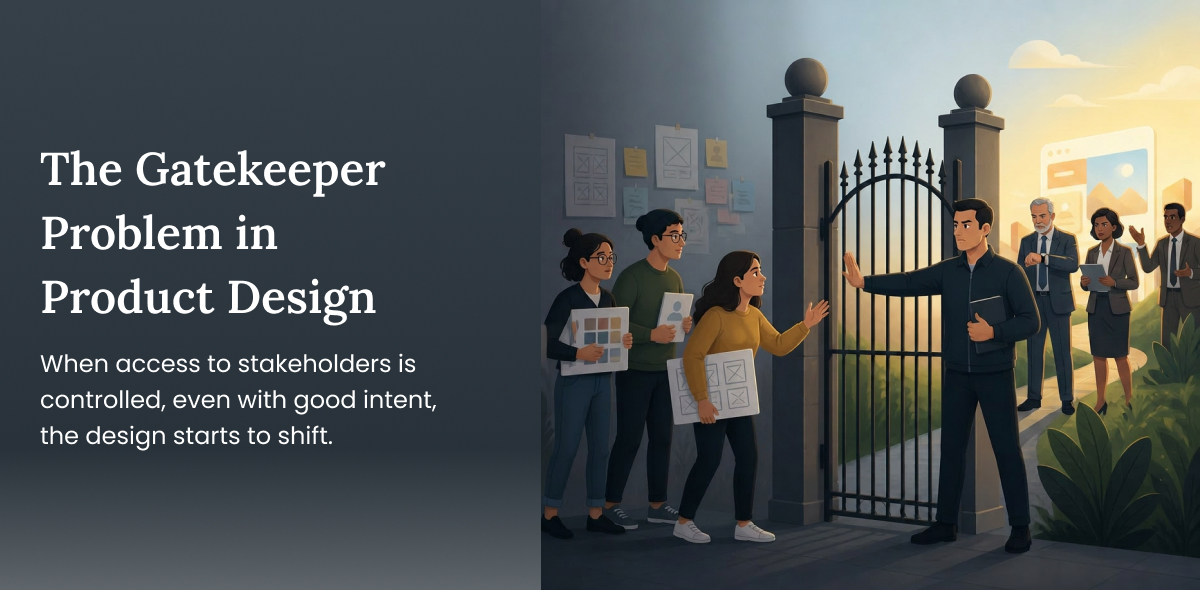
When access to stakeholders is controlled, even with good intent, the design starts to shift. It moves from being insight-driven to instruction-driven.
The Gatekeeper Problem in Product Design
Recently, a friend told me, "I'm dealing with a gatekeeper problem."
Last week, I got a call from my friend Reena, who works as a Design Lead. She asked me if I had any job references. Just a couple of months ago, we met, and she was telling me how much she was enjoying her work. She was clear she wouldn’t even think of moving for the next few years. So I asked her, what changed?
Over time, things changed. Her access became limited. Most of her conversations were now routed through Product. She primarily interacted with PMs, developers, QA, and occasionally a few users. With this, her understanding began to narrow.
This is what I hear as the Gatekeeper Problem. When access to stakeholders is controlled, even with good intent, the design starts to shift. It moves from being insight-driven to instruction-driven.
Designers shift from discovering problems to responding to them as they depend on second-hand information instead of direct exposure. You miss small but critical details and edge cases. And sometimes, even when the UX looks “good,” adoption fails because the context is incomplete.
And to be fair, this is not about blaming Product Managers or Product Leads.
Most of the time, this happens because they are trying to manage time, reduce noise, and keep things moving. There’s coordination overhead, pressure to deliver, and often a belief that stakeholder conversations are something they should own. It makes sense from their perspective, but over time, this structure creates gaps.
Designers get some of the most valuable insights from Support teams, Sales teams, or training teams, who are often the face of the customer. If designers don’t get exposure to these perspectives, that becomes a real challenge.
This is where I feel Design Ops can make a quiet but meaningful difference. By improving the structure and bringing in simple things.
- Clarifying roles: PMs drive priorities; designers drive problem understanding
- Employee Success: Identify strengths and assign goals and responsibilities accordingly
- Structured stakeholder involvement: Observations, interviews, focus group discussions, Shadowing programs or stakeholder meetings.
- Design Participation Framework: When should designers directly engage vs go through PM?
- Insight Framework: Centralised repository of research findings, support tickets, sales feedback, usability issues, customer feedback and analytics data.
- Culture of Rituals: Define and invite design teams for meetings where they have to be involved from research to ideation, be it daily standups or Voice of Customer meetings, or Web Data analytics. This creates curated exposure and aligned touchpoints instead of random conversations
Design OpsDesign Ops (Design Operations): The practice of optimising design processes, tools, workflows, and team collaboration to improve efficiency, consistency, and the overall impact of design. is not just about process. It’s about ensuring the right people, insights, and context connect at the right time. That’s how better decisions and better products evolve.
Have a story to share?
Join our community of designers sharing their experiences and insights.
Share Your Story