Compliance by Design
Healthcare UX
Design Stories
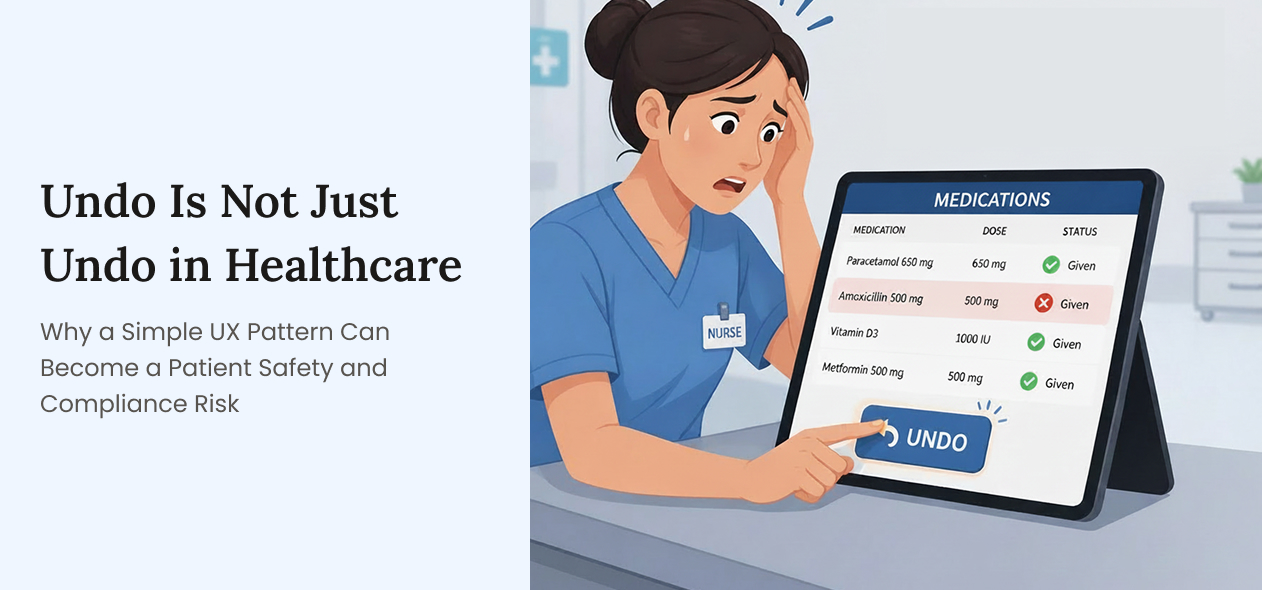
Undo Is Not Just Undo in Healthcare
An "Undo" button may seem like a small interaction pattern, but in healthcare it can influence patient safety, staff accountability, compliance readiness, and organisational trust. A Simple UX Pattern Can Become a Patient Safety and Compliance Risk.
Undo Is Not Just Undo in Healthcare
It was a busy morning in a care home.
A nurse had just finished administering medications to several residents. Between responding to a resident's request, answering questions from colleagues, and documenting treatments, she accidentally marked the wrong medication as "Administered."
She spotted the mistake almost immediately.
Her instinct was the same as it would be in most digital products: "I'll just undo it."
The record was corrected, and the day moved on.
Two weeks later, during a routine audit, the corrected entry was flagged. The auditor asked why the medication record had been changed and what had happened.
The nurse struggled to remember. After hundreds of medication administrations over the previous weeks, the details of that single incident had long faded from memory. Without a clear explanation or supporting evidence, a simple tap on a screen had become an unanswered question in an audit.
This is where healthcare design differs from consumer software.
The moment a medication is recorded as administered, it becomes part of the resident's clinical record. Reversing that action is no longer a simple interface interaction. It becomes a matter of patient safety, clinical accountability, organisational policy, and regulatory compliance.
An Undo action may appear to change only the screen, but it can affect the integrity of the medical record. It may require a reason for the change, an immutable audit trail, notifications to downstream systems, approval workflows, or reporting processes.
This is why designing healthcare products requires a different mindset.
Before deciding how an interaction should behave, we must first understand the system it belongs to. Every interaction exists within a broader clinical, operational, and regulatory ecosystem. Designing without that context may produce experiences that feel intuitive, but fail when measured against safety, governance, and compliance.
In regulated healthcare, Undo is never just Undo. It is an act of accountability.
Now imagine the same medication correction handled differently. Instead of instantly reversing the action, the system guides the caregiver through a structured correction workflow. It prompts for the reason behind the change, records who corrected and when it occurred, and, where organisational policy requires, routes the request for supervisor approval before finalising it.
The original entry is never erased; it remains part of the permanent audit trail, while the corrected entry becomes the current clinical record.
For the caregiver, the experience is reassuring rather than restrictive. The workflow provides a moment to verify the correction, encourages deliberate decision-making, and reduces the likelihood of repeated errors in a high-pressure environment.
Behind the scenes, however, the system is doing far more than processing a correction. It is preserving the integrity of the clinical record, safeguarding patient safety, maintaining a complete and auditable history of every change, and providing the evidence the organisation needs to demonstrate accountability and satisfy governance, regulatory, and legal requirements. This is where UX transcends usability and becomes a strategic enabler of safe, compliant, and trustworthy healthcare.
Taking this a step further, the best design decision is to minimise the need for an Undo action altogether. In healthcare, the safest error is the one that never happens. Many medication errors can be prevented through thoughtful UX decisions such as clear resident identification, intuitive information hierarchy, medication verification patterns, context-aware warnings, timing validations, and progressive disclosure of critical information. By preventing errors before they occur, design not only improves usability but also strengthens patient safety, reduces organisational risk, and reinforces accountability.
One of the most important lessons I've learned in healthcare design is that every interaction is part of a larger ecosystem of clinical workflows, organisational policies, regulatory obligations, and human decisions. Even something as simple as an "Undo" button can influence patient safety, accountability, compliance, and trust.
Healthcare UX cannot rely solely on consumer design patternsReusable, proven solutions to common user interface and interaction design problems. They help create consistent, intuitive, and efficient user experiences across products.. It must be designed with an understanding of the systems, responsibilities, and consequences behind every action.
Have a story to share?
Join our community of designers sharing their experiences and insights.
Share Your Story