Career & Success
Healthcare UX
Design Stories
Healthcare Slowed Me Down. It Made Me a Better Designer
Healthcare slowed me down, but made me a better designer. It made me more thoughtful. More disciplined. More aware that even small design decisions can carry significant consequences.
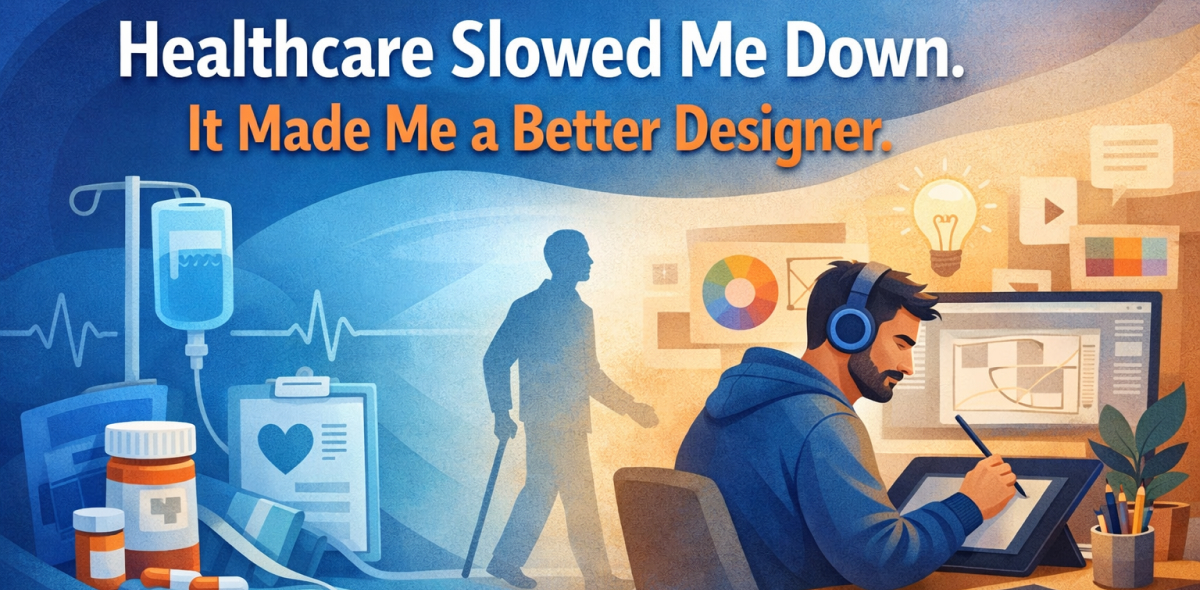
Healthcare Slowed Me Down. It Made Me a Better Designer
For nearly one and a half decades, I designed for scale. I worked on systems, optimised processes, drove adoption, aligned stakeholders, and measured success through numbers, data, ROI, and growth. I built products that performed well. The work was meaningful and strategic, but most of the time, impact was defined by metrics.
Then I stepped into healthcare, and everything changed. I stopped designing only for systems and started designing for people.
Design for life!
In healthcare, speed is not everything. Factors like clinical safety, compliance, accessibility, and data security matter more. Research needs to go deeper. Human behaviour can challenge our assumptions and must be questioned again and again. When designing for non–tech-savvy users, adoption can be slow. If a product deviates even slightly from an established workflow, hesitation creeps in. Edge cases cannot be ignored. The focus shifts from improving efficiency to protecting someone’s well-being. Impact is no longer just about growth charts.
It is about trust. About clarity. About safety.
There are moments of both joy and heaviness. On some days, during in-person user feedback sessions, care staff share their happiness about features that have simplified their work. I used to feel proud that, as a team, we had made someone’s life a little lighter. On other days, I hear about a clinical safety issue, an edge case we did not fully anticipate. On those days, my mind keeps asking, “What if I had asked one more question?” It feels heavy. Over time, I have understood that it is impossible to capture every single use case. Healthcare is complex. Human behaviour is unpredictable. Design in this space is constantly evolving, and needs are often unforeseen. Yet the responsibility remains. Even one missed use case can become dangerous. Healthcare has also taught me what failure truly means. In many industries, if design fails, it causes inconvenience or loss of revenue. In healthcare, failure can cause harm. It can create emotional stress. It can affect someone’s health. That thought changes how you work. You become slower in making assumptions. You collaborate more. You document more clearly. You review more carefully. Safety stops being just a requirement; it becomes a mindset. Healthcare systems are used by doctors, clinicians, administrators, patients, and caregivers. Many of them are tired, stressed, or making critical decisions under pressure. Designing for them requires humility. It means putting care before speed. Safety before clever ideas.
Healthcare slowed me down, but made me a better designer. It made me more thoughtful. More disciplined. More aware that even small design decisions can carry significant consequences.
It reminded me that design is not about being smart or impressive. It is about being careful, responsible, and accountable. Healthcare did not just change what I design. It changed how I understand impact.
Have a story to share?
Join our community of designers sharing their experiences and insights.
Share Your Story