Foundations
Beginners Guide
User-Centered Design - A Beginners Guide
UCD is an iterative process where designers continuously involve users through research, testing, and feedback. The goal is to create products that are intuitive, effective, and easy to use, ensuring a high level of usability while meeting both user needs and business objectives.
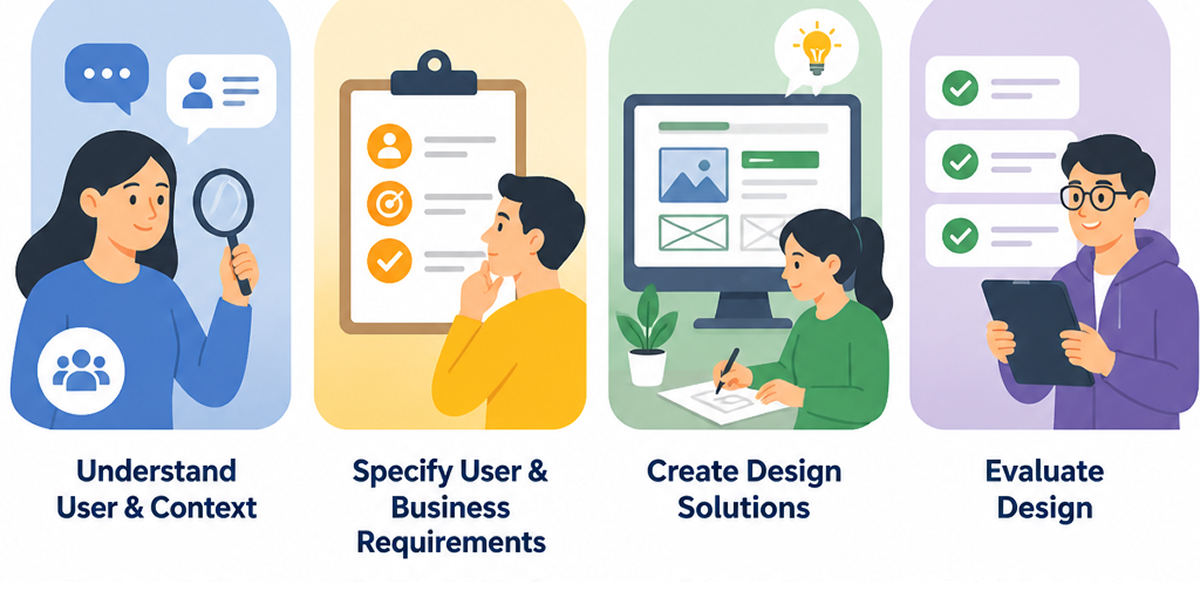
User-centred design (UCD)
User-centred design (UCD) is all about keeping the user at the core of every design decision. The term was first introduced in 1977 by computer scientist Rob Kling, but it gained wider recognition through Don Norman’s influential books, User-Centred System Design (1986) and The Design of Everyday Things (1988).
UCD is an iterative process where designers continuously involve users through research, testing, and feedback. The goal is to create products that are intuitive, effective, and easy to use, ensuring a high level of usability while meeting both user needs and business objectives.
Key Phases of the UCD Process
Understand the user and context:
Research who the users are, their goals, challenges, and how they interact with the product. Observing their behaviours and environment helps guide design decisions.
Specify user and business requirements:
Define both the user needs and business objectives, including technical requirements, clear goals, and metrics to measure success.
Create design solutions:
Develop storyboards, wireframes, user flows, and mockups. Test interface elements and plan the information architecture, iterating continuously to refine the product.
Evaluate designs:
Conduct usability testing, preferably with real users, to gather feedback, identify what works, and improve what doesn’t.
When to Use UCD?
UCD is especially useful for refining existing products, improving efficiency, and solving well-defined problems.
Challenges in UCD
One of the main challenges in user-centred design is the time and resource constraints. Conducting thorough user research and testing takes considerable effort, especially when users are unable to articulate their needs well and require in-depth, immersive studies. Another common difficulty is balancing priorities, as aligning user needs with business objectives can be complex and often involves careful negotiation. Stakeholder buy-in is also a hurdle, since convincing decision-makers of the value of a user-centred approach typically requires clear evidence. Finally, the iterative nature of UCD demands ongoing commitment, with continuous testing, refinement, and resources needed throughout the design process.
Best Practices for UCD
To address these challenges, certain best practices can help make UCD more effective. Early and continuous user involvement ensures that users are engaged at every stage, helping the product meet real needs. Employing clear research methods, such as surveys, interviews, and observations, provides actionable insights that guide design decisions. It’s important to prioritise feedback, focusing on recurring patterns rather than individual opinions to make informed choices. Iterative prototyping is another key practice, starting with low-fidelity versions and refining gradually to save time and resources. Encouraging cross-functional collaboration between designers, developers, and stakeholders helps balance usability, feasibility, and business goals. Finally, documenting findings from research, design iterations, and user feedback ensures continuity and clarity throughout the design process.
User-centered design may take effort and time, but the result is products that truly work for people, making their experience smoother, simpler, and more satisfying.
Have a story to share?
Join our community of designers sharing their experiences and insights.
Share Your Story